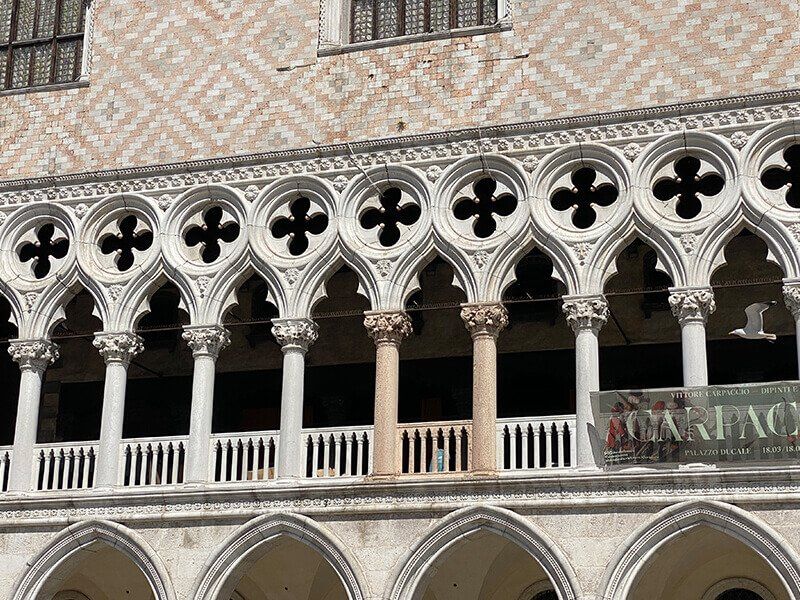
The two pink marble columns on the first floor of the Doge’s Palace
Looking at the façade of the Doge’s Palace on St. Mark’s Square, you can notice two pink marble columns on the first floor, different from the others. This detail, which at first might seem like an artistic whim, is in fact an architectural feature that often goes unnoticed by tourists visiting Venice. Yet these columns have a very particular history that makes them an important symbol of the city’s past.
According to legend, it was the Doge himself who requested that these two pink marble columns be added to the façade of the Doge’s Palace, so that death sentences could be read directly to the square and the people could see and take part in the executions.
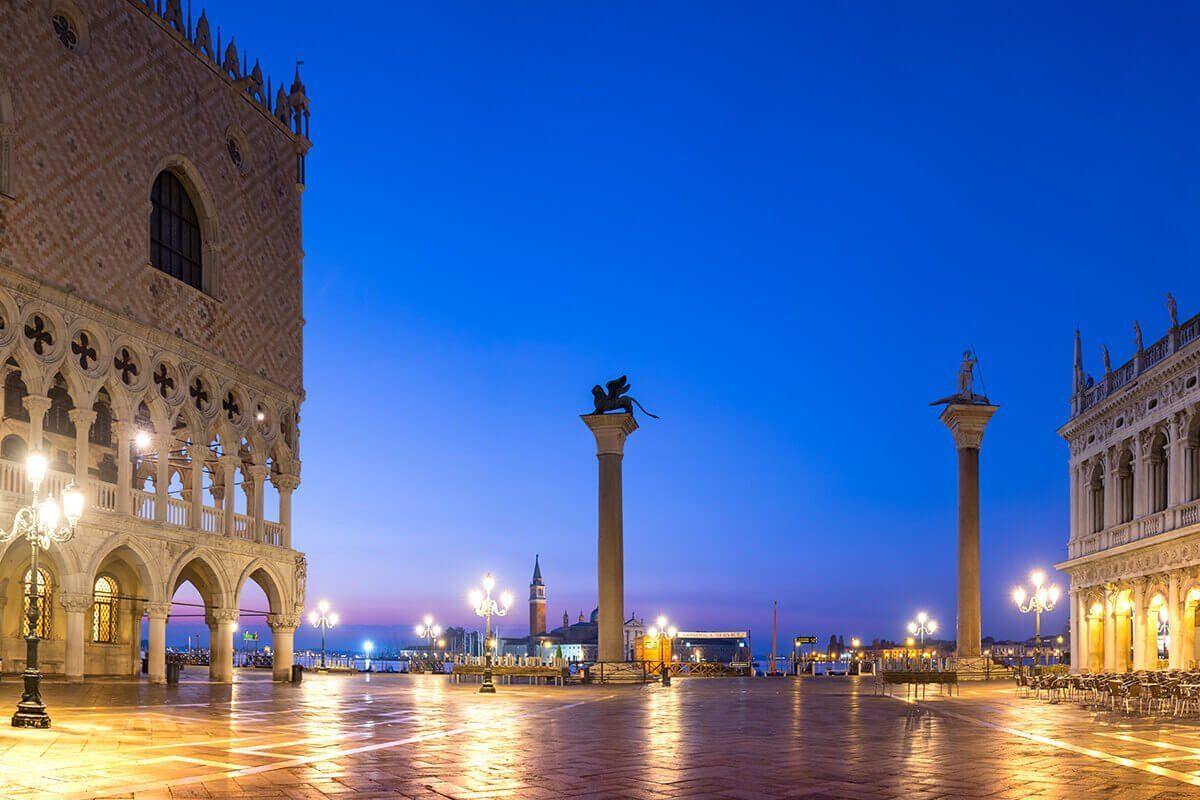
The columns of St. Mark and St. Theodore, public executions
The column of St. Mark, about 15 metres high, is made of Carrara marble and topped by the winged lion, symbol of the Most Serene Republic of Venice. The column of St. Theodore, on the other hand, is made of pink granite and is about 13 metres high. It represents the first protector of Venice and of the Venetians, St. Theodore, depicted in the act of slaying a dragon.
Originally, beneath the columns of St. Mark’s Square there were wooden workshops where handcrafted goods were sold. In the Renaissance, however, capital executions took place between the two columns, and this is why the superstitious custom of not walking through the space between the columns still persists today.
At the time of the Serenissima, the columns were used as a kind of stage for carrying out death sentences. This is where the public watched the executions of those who had committed the most serious crimes, such as treason or espionage against the Republic of Venice. It was a public event, and the sight of the columns served as a warning to others of what could happen to anyone who disobeyed the law.
In reality, the two columns were not used for many executions, but their symbolic meaning remained very strong in Venetian culture. Death was considered a very severe punishment, yet a necessary one to maintain order in the city. For this reason, death sentences were read in public and carried out immediately afterwards.
The benefit of the last turn, also known as “the judgement of St. Mark”
The benefit of the last turn, also known as the judgement of St. Mark, was a very peculiar judicial practice in Venice at the time of the Serenissima. It consisted in asking for a last chance of salvation, namely trying to walk around a column on the façade of the Doge’s Palace facing St. Mark’s Basin. This column of St. Mark’s Square was different from the others, a few centimetres thicker, and it was chosen because on the day of the Redentore the shadow of the statue of St. Mark seems to point to it.
The last turn was granted to those sentenced to death for a crime not connected to treason. To obtain this pardon, the condemned man had to approach the column, lean against its base, embrace it from behind and try to go around it while keeping his feet on the step. If he succeeded, he was pardoned and released immediately. If he failed, he would fall into the water and then be executed.
It is not clear whether anyone ever managed to pass the judgement of St. Mark, but it is unlikely that any success would have been made public, since the Ten, like any judge, did not like the idea of being in the wrong.
Today, if you are wandering around Venice, you can still see this column and touch it with your own hands. This ancient symbol of justice and hope bears witness to the history of Venice and its justice system.