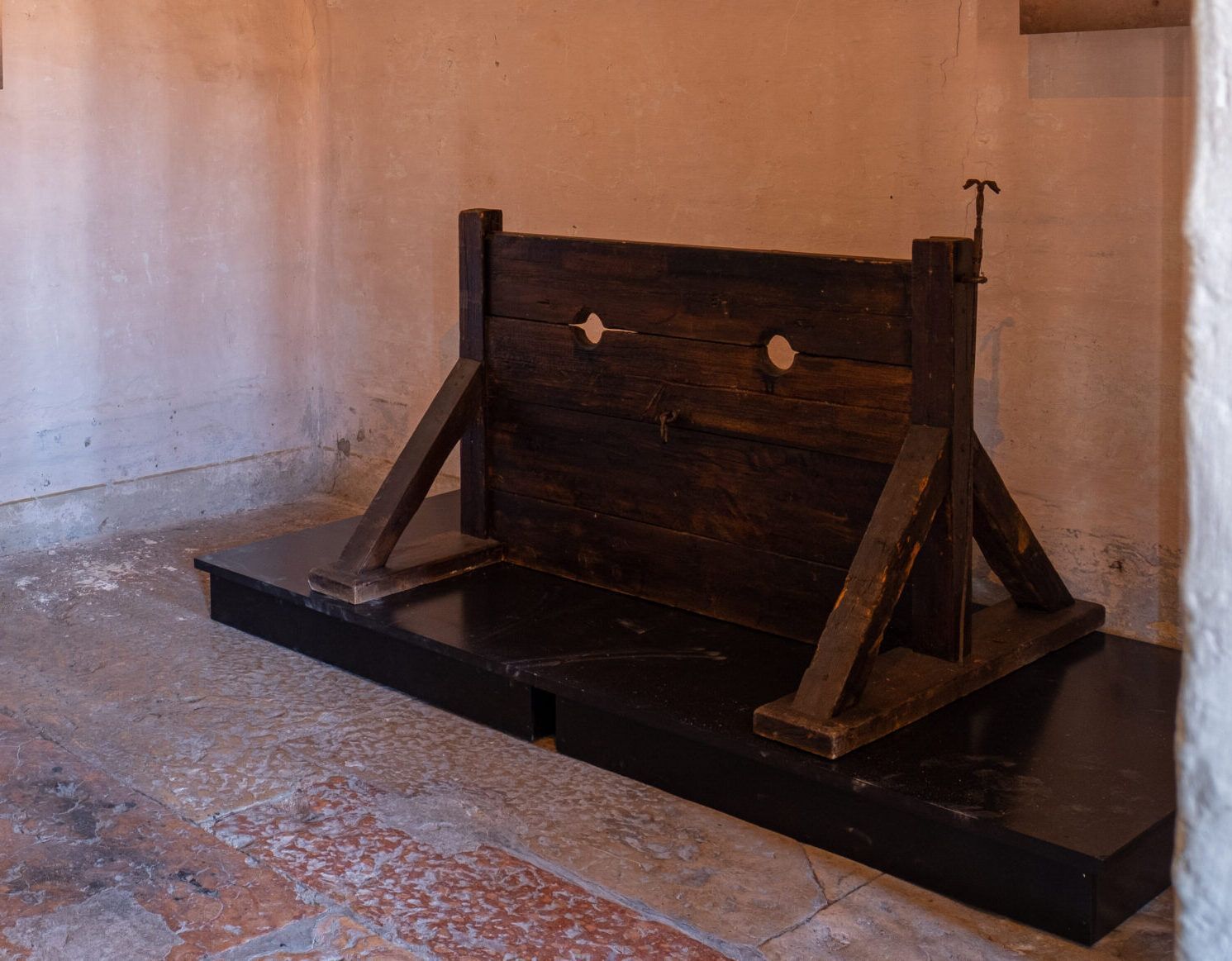
So what is the pillory (berlina)?
The pillory (berlina), a medieval instrument of torture, was a degrading punishment of ancient barbarian origin, used above all in the Middle Ages but still practised in the 19th century. The condemned was chained and exposed to the public, often on a platform, usually with an indication of the crime committed. Sometimes the crime was proclaimed by a town crier who accompanied a cart on which the unfortunate was loaded and led through the city streets.
The column of justice
Over time it evolved from an iron collar, fixed to a column by a chain tightened around the neck of the condemned, into hinged wooden boards with holes through which the prisoner’s head and/or limbs were inserted, then locked together to hold him.
In Venice the offender was put in the pillory with a mitre or a paper crown on his head and exposed to the abuse and mockery of the public for a few hours a day.
In some of its variants it was called the “Column of Justice” or the “Infamous Column” because it consisted of a stone column standing in the middle of the public square. Sometimes it took the form of a human-shaped stone statue.
Rialto: exposure on the pillory platform
In Venice, exposure on the pillory platform took place at Rialto, and from 1372 it was moved between the two columns of St. Mark and St. Theodore. The punishment was reserved for those guilty of minor crimes and usually struck common people.
The origin of the expression “to be put in the pillory”
In Italian, “mettere alla berlina” is an expression that, figuratively, means to expose someone to public ridicule, just like “to pillory” someone in English.
Visit the Prison Palace (Prigioni Nove) in Venice
The Prison Palace still offers the opportunity to see the instruments of torture, the cells and period costumes, and to discover stories and legends of a distant Venice. A piece of history that bears witness to the machines of death and torture once used as instruments of justice.