What were Venetian galleys?
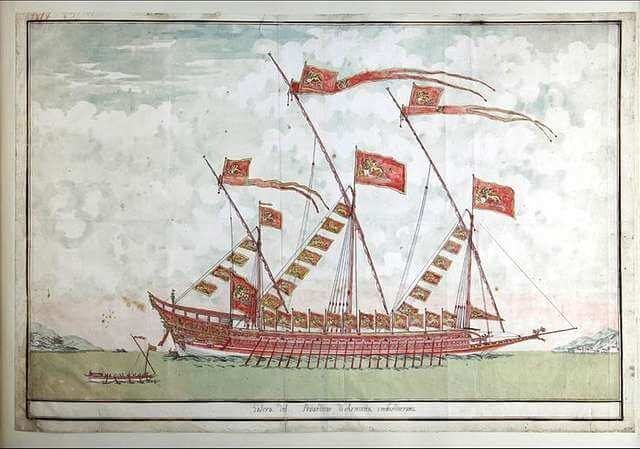
Venetian galleys were warships and merchant ships typical of the Republic of Venice during the medieval and Renaissance periods, especially between the 11th and 17th centuries. They were long, slender oared vessels, designed for sailing both on the open sea and in the shallower waters of the Venetian Lagoon.
Together with the “Lion of St Mark”, the Venetian galley is undoubtedly one of the most representative symbols of the thousand-year history of the “Serenissima” Republic of Venice, playing a crucial and decisive role in the greatness and influence of Venice in the ancient world.
Where does the word “galley” come from?
The name “galea” most probably derives from the Greek word “galeotes”, associated with the slender, menacing shape of the bow, similar to a shark. In Venetian dialect, however, “galia” refers to an insect called the “millipede”. This chilopod has an elongated body with twelve pairs of long legs which, moving quickly, recalls a galley advancing under oars.
The first galleys in Venice
The term “galeas” first appears in a manuscript by the Byzantine emperor Leo VI, suggesting that the Byzantine galley was developing its own identity in the 9th century. The first galley prototypes were used successfully at the Battle of Dyrrhachium against the Normans in 1081.
What was a Venetian galley like?
From the very beginning, the first galley prototype had a ram on the deck, similar to that of the triremes of classical antiquity. Its main purpose was to smash the oar bank of the enemy ship, causing structural damage to the whole hull. The first galleys were fitted with two lateral stern rudders, similar to large stern oars, and a large triangular sail.
Contrary to what one might think, they sailed mainly under canvas. This was to avoid having an exhausted crew of oarsmen during clashes with the enemy or in bad weather. What is more, on the first galleys each oarsman had just one oar, so there were two oarsmen on each bench.
Galleys in the 12th century
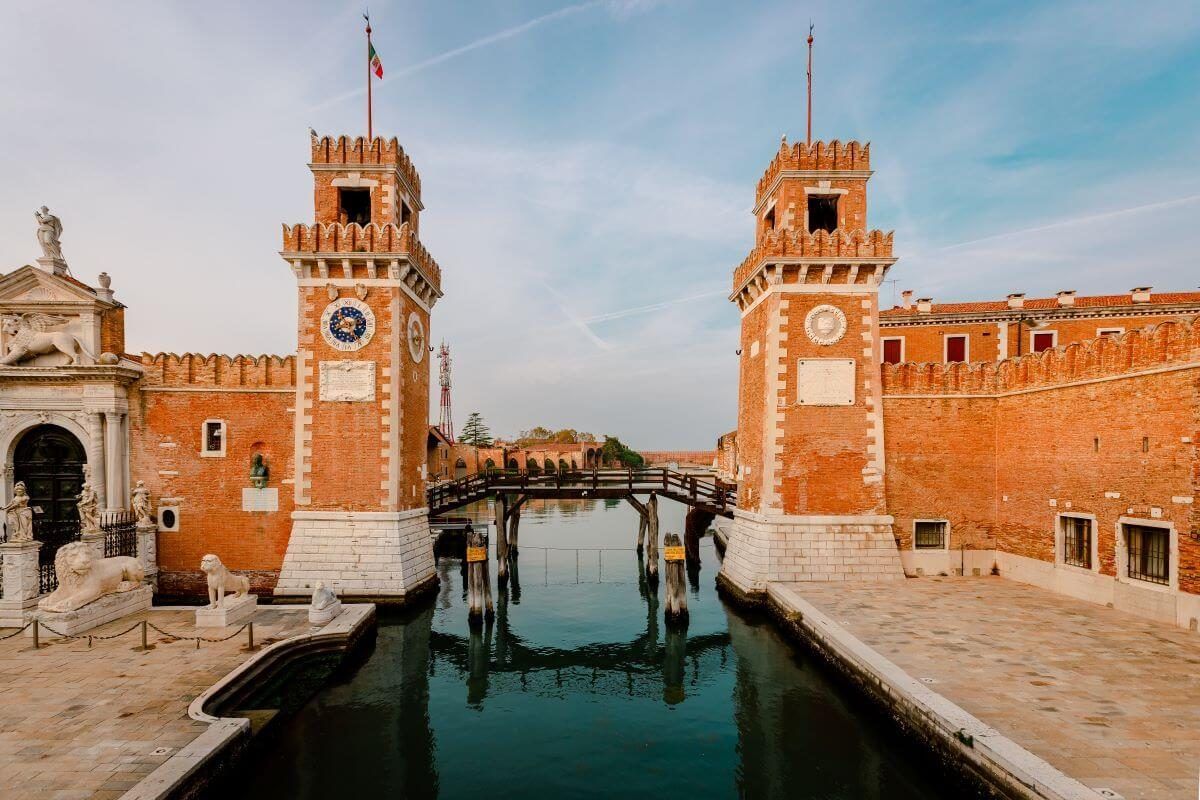
Venetian galleys were remarkably versatile and adapted well to both the military and commercial needs of the time. From the year the Arsenal was founded, around 1104, galleys became an entirely state-owned product intended for both military use and commercial purposes.
During the Crusades, they were used both as transport ships for troops and supplies and as warships to protect convoys and take part in naval battles.
Changes in routes, their length and the volume of goods to be carried contributed to the increase in the size of the galleys. Their mobility and manoeuvrability made them an important naval force in the Mediterranean. Venetian galleys were propelled both by the strength of oars handled by well-trained crews and by the power of the wind, using auxiliary sails when necessary. Their construction was technologically advanced for the time, and the Republic of Venice jealously guarded the knowledge of their design and construction.
In the 12th century, the galley prototype had the following features:
- The hull was about 38 metres long and less than 4.5 metres wide.
- Its sides were fitted with 27 benches rowed “alla sensile”, with two oarsmen per bench, for a total of 108 men at the oars.
- Its cargo capacity was approximately 25 tonnes.
Who rowed the galleys?
Until the mid-16th century, the crews of Venetian galleys were made up mainly of free men called “Bonevoglie”. These were mostly young citizens of Venice or of the territories subject to the Republic, who were enlisted to do military service. Young volunteers aged between 18 and 40 were also recruited and received a regular wage.
When labour was in greater demand, the “Bonevoglie” were joined by prisoners captured on enemy ships, sea raiders, traitors, rogues, thieves and deserters who had escaped from the Serenissima’s prisons. These men were forced to row in chains to meet the needs of the Venetian fleet.