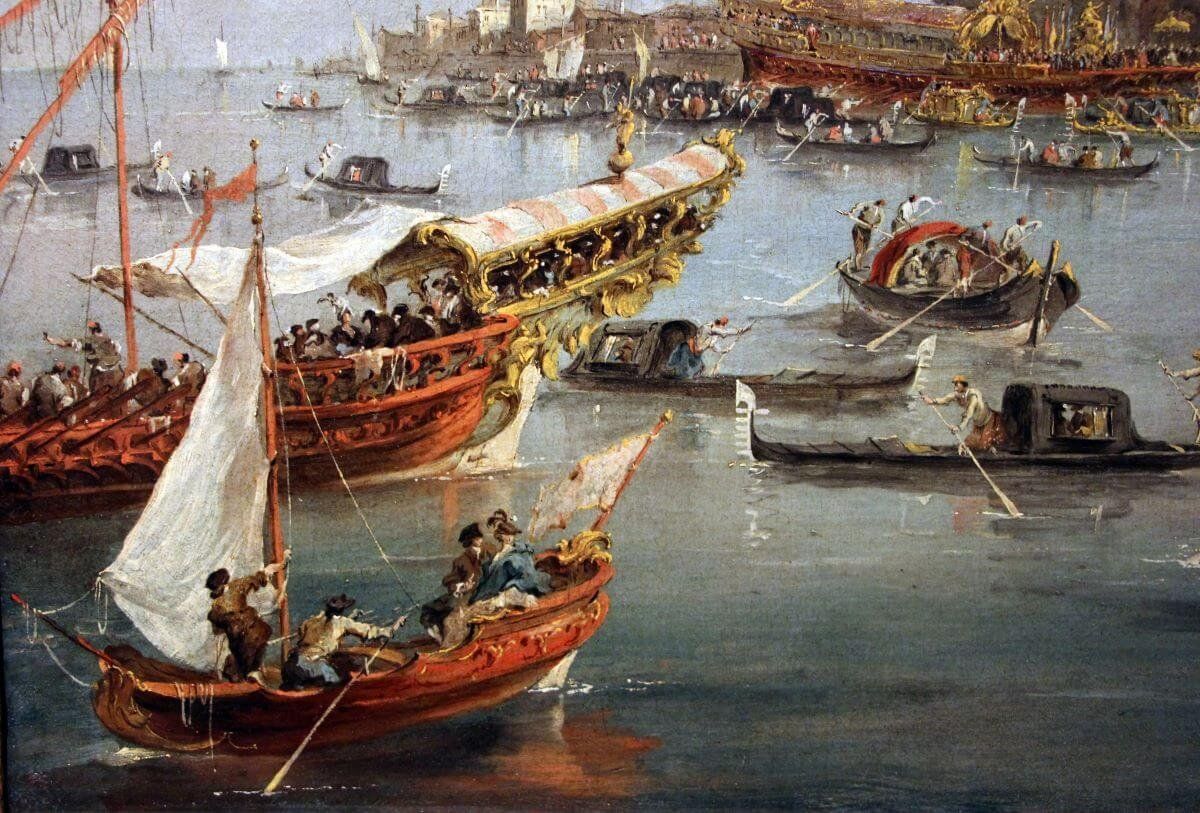
The Bucintoro of Venice, the Galley of the Doges of Venice
The Bucintoro was the imposing state galley used by the Doges of Venice.
Every year, on Ascension Day, they boarded this magnificent vessel to celebrate the Venetian rite of the “Marriage of the Sea”, to express their symbolic bond with the sea and renew Venice’s control over the surrounding waters. This event highlighted the importance of the Most Serene Republic as a maritime and commercial power.
Although the Bucintoro played a ceremonial role, it was also a functional ship, equipped with luxurious cabins and spaces for official meetings. Over the centuries, the galley underwent several renovations and reconstructions, culminating in the most majestic version, which became the emblem of Venetian celebrations.
The Bucintoro of Venice, destroyed by the French occupiers
However, at the end of the 18th century, in 1798, Napoleon Bonaparte abolished the Feast of the Ascension and, after occupying Venice, had the Bucintoro destroyed in 1807. From then on, the imposing state galley was lost forever, but its memory lives on in historical accounts and in the works of art depicting the splendid moments of the ancient Venetian celebrations.
Origin of the name “Bucintoro”
The name “Bucintoro” derives from the Venetian term “buzino d’oro” (burcio d’oro), which was later Latinised in the Middle Ages as “bucentaurus”, referring to a supposed mythological creature similar to a centaur, but with the body of an ox. This name is attested by the historian Sanudo.
However, some have mistakenly suggested that the name derived from an ox head used as the galley’s figurehead. This hypothesis is unfounded, since the term “bucentaurus” has no counterpart in Greek mythology.
Interestingly, the name Bucintoro seems to have been used generically to indicate any large and sumptuous Venetian galley.
The Doge of Venice on the Bucintoro for the Ascension – Francesco Guardi. Source: Wikimedia Commons